“The Enigma machine was a marvel of engineering, but it was human error that ultimately exposed its secrets.” – The Smithsonian. It didn’t just shape the war; it shaped the future. The global race to break its codes pushed mathematics, engineering, and early computing into entirely new territory. In many ways, the story of Enigma is the story of how modern encryption began.
A Cipher That Changed the World
The Enigma machine is often remembered as a World War II artifact — a mysterious box of rotors and lights used by Nazi Germany to encrypt military messages. But its impact didn’t end in 1945. Enigma didn’t just shape the war; it shaped the future. The global race to break its codes pushed mathematics, engineering, and early computing into entirely new territory. In many ways, the story of Enigma is the story of how modern encryption began.
What Was the Enigma Machine?
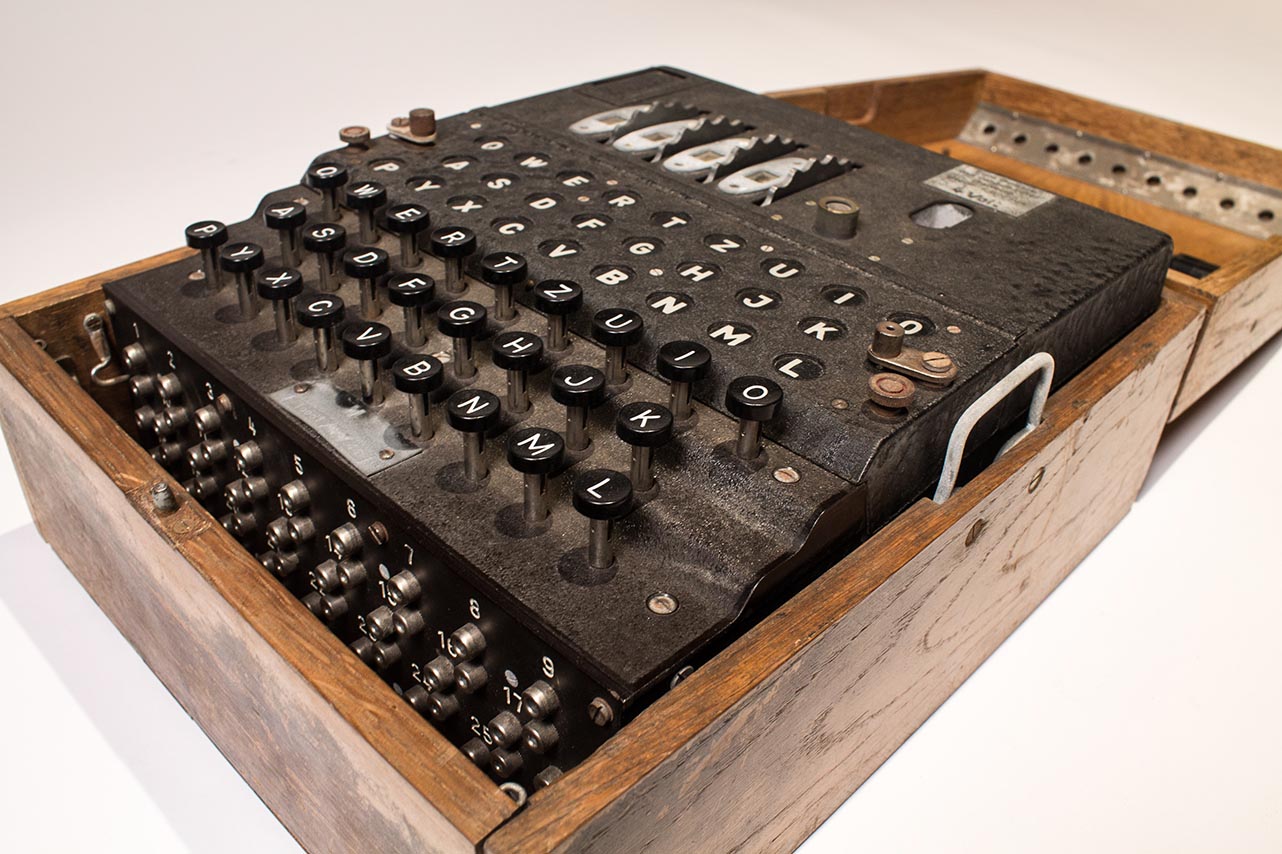
The Enigma machine was an electromechanical cipher device that scrambled letters using:
- Rotors that shifted electrical pathways
- A plugboard that added extra swaps
- A lampboard that displayed encrypted output
- A keyboard for input
Each keypress produced a different letter, creating a constantly changing cipher. With trillions of possible settings, Enigma seemed unbreakable.
How Codebreakers Broke the “Unbreakable”
- The Polish Foundation
Polish mathematician Marian Rejewski reverse‑engineered the wiring using permutation theory. His team built early replicas and shared their findings with Britain and France. - Bletchley Park and Alan Turing
At Bletchley Park, Alan Turing and Gordon Welchman created the Bombe, a machine that rapidly tested possible Enigma settings. It didn’t solve the cipher instantly — it narrowed the search so human analysts could finish the job. - Human Error: The Hidden Weakness
German operators made predictable mistakes:- Repeating message headers
- Using common phrases
- Sending weather reports in standard formats
These “cracks” in procedure gave codebreakers the footholds they needed.
How the Enigma Machine Led to Modern Encryption
- Enigma Inspired the First True Computers
Turing’s work on the Bombe — and later the Colossus machine — laid the foundation for computer architecture. These early machines showed that:- Machines could perform logical operations faster than humans
- Cryptography could be automated
- Mathematics and computing were inseparable in codebreaking
Modern encryption algorithms like AES, RSA, and SHA‑256 rely on the same principle:
computers performing complex mathematical transformations at high speed.
- It Proved That Security Depends on Both Math and Human Behavior
Enigma taught cryptographers a crucial lesson:- A system is only as secure as the people using it.
- Today, cybersecurity still deals with:
- Weak passwords
- Reused keys
- Misconfigured systemsHuman error in secure communication
- It Pushed Cryptography Toward Mathematical Rigor
Before Enigma, many ciphers were based on linguistic tricks or simple substitution. Breaking Enigma required:- Group theory
- Permutation theory
- Probability
- Algorithmic thinking